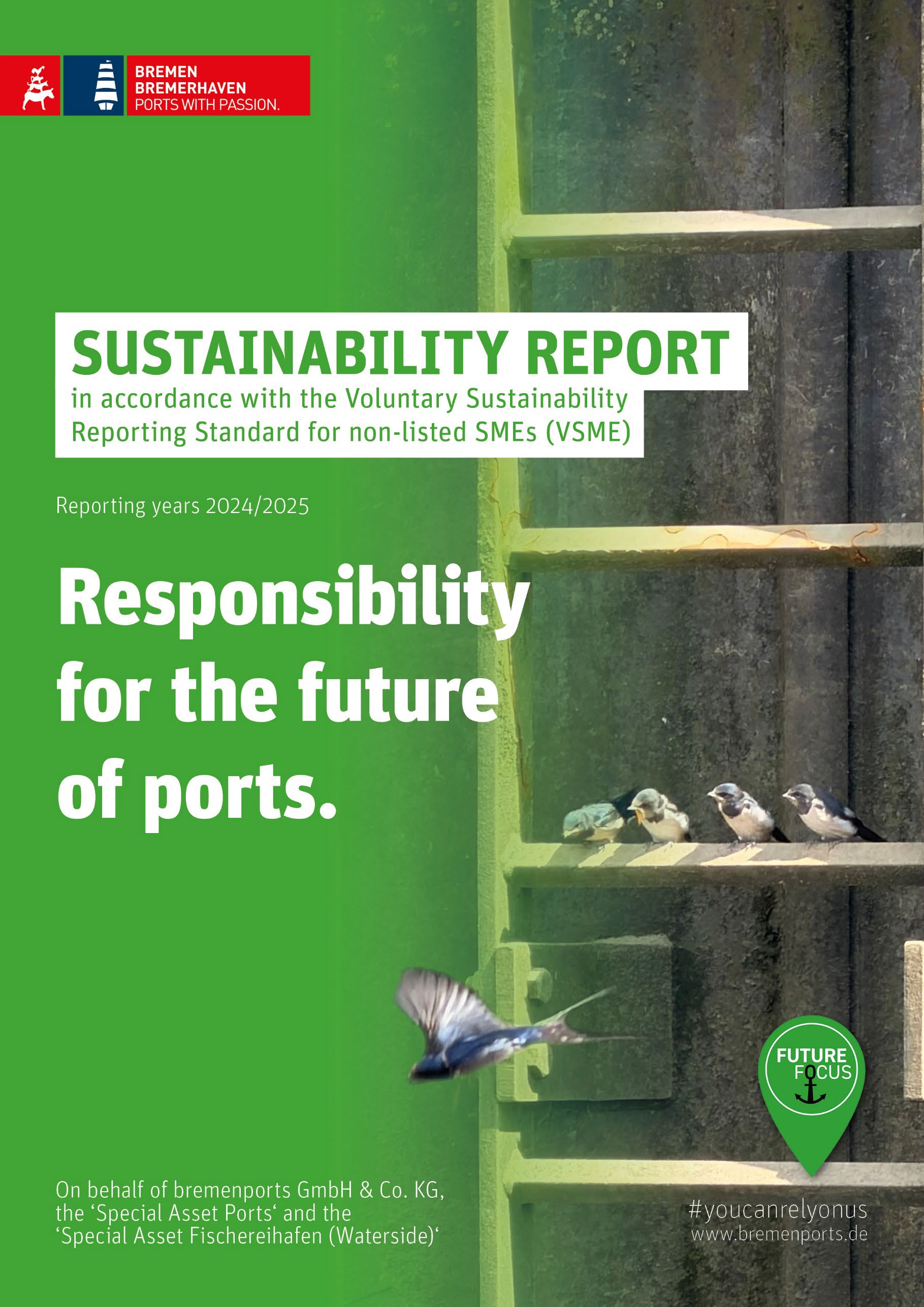
bremenports publishes new sustainability report for the first time in accordance with the European VSME standard
Climate change, the energy transition and increasing requirements for sustainable business practices are also transforming port development. In its new 2026 Sustainability Report, bremenports explains how the port management company is responding to these challenges. For the first time, the report has been prepared in accordance with the European Voluntary Sustainability Reporting Standard for SMEs (VSME). It covers the 2024 and 2025 financial years and includes not only bremenports but also the special funds for the ports and fishing port managed by the company.
The company's tenth sustainability report to date is entitled “Responsibility for the Ports of Tomorrow”. It documents progress, challenges and specific targets in the areas of the environment, social responsibility and responsible corporate governance. In addition to the VSME Basic Module, bremenports has also implemented the Comprehensive Module.
“Sustainability is not an additional issue for us, but a fundamental principle guiding the development of the Ports of Bremen. Our aim is to ensure that the ports remain economically strong, environmentally responsible and socially balanced. The new report shows what we have already achieved, while also providing transparency about the major challenges that still lie ahead,” says Robert Howe, Managing Director of bremenports.
New standard broadens the perspective
Since 2013, bremenports had prepared its sustainability reports in accordance with the internationally recognised standards of the Global Reporting Initiative (GRI). By switching to the VSME, the company is responding to the ongoing development of European sustainability reporting. The aim is to establish a more harmonised framework that presents sustainability information in a transparent and comparable way.
One key innovation is the double materiality assessment. Whereas previously the focus was primarily on the positive and negative impacts of bremenports' activities on the environment and society, a second perspective has now been added: the assessment also examines how environmental changes and social developments may affect the company. This is particularly important for a port location. Rising water levels, storm surges, heat, heavy rainfall and severe weather events can affect port infrastructure, lead to operational restrictions and generate additional costs. Climate protection and climate adaptation are therefore considered together and are to be permanently integrated into the planning, operation and maintenance of port infrastructure.
Carbon footprint becomes significantly more comprehensive
Another innovation concerns the carbon footprint. For the 2025 financial year, bremenports is reporting extensive so-called Scope 3 emissions for the first time. These are indirect emissions arising, among other things, from the procurement of goods and services, capital goods, upstream energy supply chains, waste, employee commuting and rented, leased or granted land and facilities. Previously, only emissions from business travel were recorded in this category.
For 2025, Scope 3 emissions were calculated at approximately 509,000 tonnes of CO₂ equivalents. By far the largest share is attributable to long-term leased tangible assets, over whose operation bremenports has only limited influence. As Scope 3 emissions were assessed on this scale for the first time in 2025, a direct comparison with the previous year is not possible. Some elements of the carbon footprint are also based on well-founded estimates and projections.
In 2025, directly generated Scope 1 emissions amounted to approximately 1,516 tonnes of CO₂ equivalents, while market-based Scope 2 emissions totalled 93 tonnes. To reduce these emissions, bremenports is focusing, among other measures, on electrifying its vehicle fleet, installing heat pumps and photovoltaic systems, and, in the longer term, introducing renewable propulsion systems for its working vessel fleet. The aim is to fully phase out fossil fuel-based market-based Scope 1 and Scope 2 emissions by 2035. For Scope 3, the company is targeting a reduction of at least 20 per cent by 2035 compared with 2025.
Sustainability goes beyond climate protection
The report also makes clear that sustainability at bremenports extends far beyond the carbon footprint. Topics include flood protection and climate adaptation, as well as air and water quality, biodiversity, the circular economy, occupational health and safety, professional development, work-life balance and responsible corporate governance.
Ecological compensation plays a particularly important role. To date, bremenports has created around 1,700 hectares of compensation areas. Approximately 1,000 hectares of these are located on the Luneplate/Tegeler Plate alone. The Luneplate is an EU-designated Special Protection Area for birds and the largest nature conservation area in the state of Bremen. Ecological measures are continuously monitored and assessed. In 2025, 96 per cent of the areas evaluated were classified as functioning effectively or better.
Dredged material management also demonstrates how sustainability and traditional port management go hand in hand. Of the approximately 116,000 cubic metres of non-hazardous dredged material generated in 2025, around 84,500 cubic metres were sent for recovery or reuse. Of this amount, approximately 78,600 cubic metres were recovered as materials and used for internal construction projects. Suitable processed dredged material can, for example, be used as a secondary raw material in construction and land reclamation projects, as well as in dyke construction.